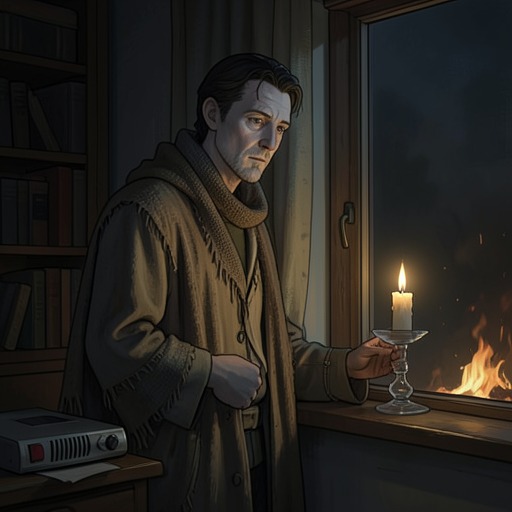
Fear of Death and the Will to Live
Of Human BondageFear of Death and the Will to Live is a recurring concern in Philip Carey’s encounters with illness and mortality. Its most intimate development comes through the final illness of his uncle, Mr. Carey: a clergyman who believes in life after death yet fears dying, and whose last days unsettle Philip’s assumptions about religion, courage, and human dependence. The theme also gains a professional dimension as Philip learns medicine among patients whose suffering cannot be reduced to diagnoses.
Belief and the Clinging to Life
Mr. Carey’s fear is striking because it persists alongside religious conviction. He believes in the immortality of the soul and considers heaven a likely destination, but Philip sees that these assurances do not make his uncle willing to die. To Philip, the old man’s eagerness to remain alive suggests an unspoken horror before the unknown, a fear that formal religious consolation cannot simply remove.
As Mr. Carey’s health deteriorates, Philip observes the contradiction more closely. His uncle receives Holy Communion and reads the Bible, yet regards death with dread. In constant pain, dependent on others, and no longer hoping to return to the open air, he clings to the familiar world. Philip wonders whether, beneath his uncle’s conventional religious responses, there might be a private suspicion that there is no God and nothing after death. The thought remains Philip’s conjecture, not a belief Mr. Carey confesses, but it reveals how little his outward faith enables Philip to know of his inner life.
The Final Illness and a Change in Philip
When Mr. Carey calls Philip to his bedside and says that he thinks he is going to die, Philip tries to reassure him. The old man’s tears disclose a terror that Philip has not seen in him during ordinary life. He asks Philip to hold his hand, and Philip gives it to him. In that moment, the uncle who had seemed emotionally remote turns instinctively to another person for comfort. Philip recognizes that his uncle is fighting the fear of death and that such fear is not peculiar to him; all human beings, Philip thinks, must pass through this ordeal.
The encounter alters Philip’s response to a relationship marked by resentment. For two years he had longed for his uncle’s death, yet now he cannot resist the compassion stirred by his uncle’s helplessness. His reaction also turns into a challenge to religious belief: the suffering of the dying seems monstrous to him, difficult to reconcile with a God who permits such fear. Mortality thus becomes not only a private crisis for Mr. Carey but a test of Philip’s own atheistic judgment and capacity for sympathy.
Communion, Acceptance, and Its Limits
After the curate administers Communion, Philip finds his uncle changed. The terror has left his face, and Mr. Carey says that he is prepared to die and entrust his soul to God. Philip believes that the old man is sincere: receiving the sacrament has given him strength to accept what had frightened him. He adds that he will rejoin his wife, recalling a love that Philip remembers as poorly returned during her life.
This acceptance is real but does not erase the fear that preceded it. The narrative places a period of dread beside a moment of religious assurance, rather than treating belief as a permanent immunity from death anxiety. Mr. Carey’s renewed composure gives him a way to face the inevitable, while Philip witnesses its force without adopting his uncle’s faith. The scene makes room for both the sustaining power of religious practice and the uncertainty Philip continues to feel about what lies beyond life.
Mortality in Medical and Ordinary Life
The theme extends beyond Mr. Carey’s sickroom through Philip’s work at St. Luke’s Hospital. In the outpatient department he encounters people of different ages and circumstances, learning how patients respond differently to serious diagnoses: one may meet danger with humor, another with despair. His attention to their expressions, speech, and confidence in him makes clinical work an encounter with individual lives, not merely a succession of cases. The contrast with his earlier artistic ambitions is important: direct contact with patients gives him a new sense of involvement and purpose.
Later, in the hospital district, Philip attends difficult confinements among families living with severe material hardship. In one case, despite the efforts to keep a woman alive, she dies before dawn. Her husband stands beside the bed in bewilderment, while Philip and the doctor gather their things and the husband explains that there is nowhere for him to lie down. This episode places death within conditions of poverty and constrained care, rather than in the relative shelter of a household attended by a clergyman and housekeeper. Across these encounters, the novel presents the will to live and the fear of death as human realities shaped by belief, dependence, medical attention, and circumstance.